How to Plan a Seasonal Marketing Campaign for Your E-commerce Website
If you run an e-commerce website, the calendar is one of your biggest assets.
Every year, the same dates roll around. To name but a few – Valentine’s Day, Easter, summer, back to school, Black Friday, Christmas. Each one brings a reliable wave of consumer intent, people actively looking to buy, often with a deadline in mind. Businesses that prepare for these moments tend to make the most of them.
The good news is that you do not need a big budget or a dedicated marketing team to run effective seasonal campaigns. You need a plan, a website that is set up to support it, and a clear idea of what you want to achieve.
Why Seasonal Marketing Works
Seasonal campaigns work because your customers are already thinking about their needs. When someone is searching for a Mother’s Day gift in February, they are not browsing idly. They are ready to buy. Your job is to be findable, relevant, and easy to buy from.
There is also a useful sense of urgency built in. A limited-time promotion tied to a specific date gives people a reason to act now rather than come back later. And in e-commerce, ‘later’ very often means ‘never’.
Done well, seasonal campaigns can deliver some of the year’s strongest returns. Research suggests that well-planned seasonal activity can boost revenue by 30% to 40% compared with equivalent non-seasonal promotions. But the secret to success is in the prep.
Start Earlier Than You Think
The most common mistake with seasonal campaigns is starting too late. If you are updating your website, creating landing pages, writing email sequences, and briefing any design work, you need at least six to eight weeks of lead time before the campaign goes live.
That timeline is not just about getting the work done. It is about giving Google enough time to index your new pages and start ranking them before peak search interest arrives. A Christmas gift guide published on the 20th of December won’t do much for your organic traffic. The same guide published in early November is a different story.
A simple way to stay ahead is to map out the key and relevant dates in your retail calendar at the start of the year and work backwards from each one. Block out the planning and build time before anything else.
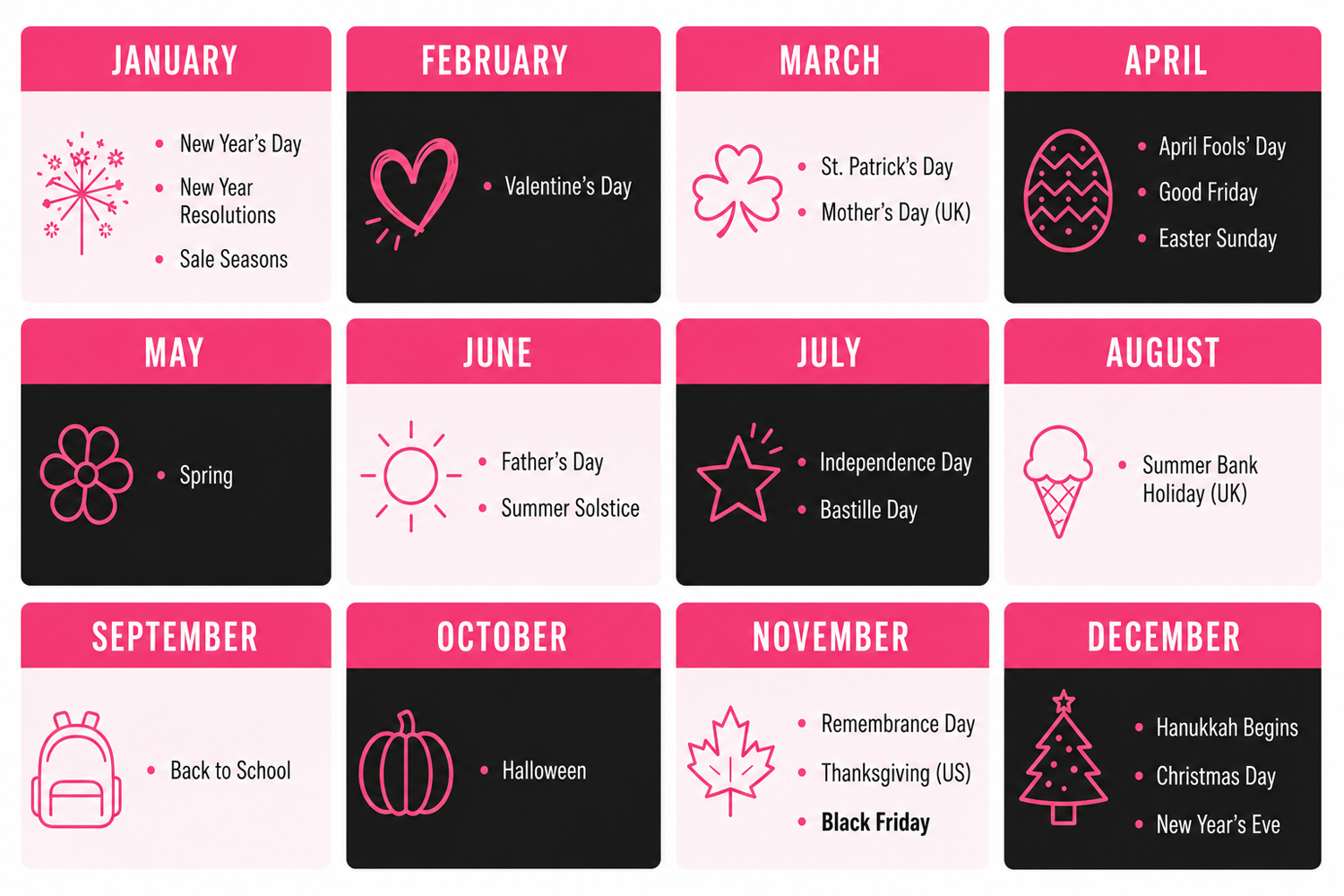
The Key Dates Worth Planning For
Not every seasonal moment will be relevant to every business, so it is worth being selective rather than trying to react to everything. Focus on the occasions that genuinely align with what you sell and who you sell to.
Key dates might include:
- January: New Year’s resolutions, sale season, and fresh-start purchases
- Valentine’s Day: Gifts, experiences, and anything with a personal touch
- Easter: Family-focused products, food, and gifting
- Mother’s Day and Father’s Day: One of the most reliable gifting peaks of the year
- Summer: allowing themed promotions
- Back to School: can be relevant well beyond stationery and uniform retailers
- Halloween: Growing significantly year on year in the UK
- Black Friday and Cyber Monday: again, growing in popularity in the UK
- Christmas: Planning should begin in October at the latest
You do not need a full campaign for every one of these. Even a targeted email to your existing customers, a banner on your homepage, or a temporary landing page can make a meaningful difference to sales during peak periods.
What Makes a Seasonal Campaign Actually Work
A clear offer.
Your customers should understand within a few seconds what you are promoting, why it is relevant right now, and what they need to do. Vague seasonal messaging, such as a banner that says “Christmas is coming”, does not give anyone a reason to click. A specific offer does.
A sense of urgency.
Seasonal promotions have a built-in natural deadline, and it is worth making that visible. Countdown timers, last-order dates for guaranteed delivery, and limited-stock messaging all encourage faster buying decisions.
Relevant product groupings.
Curated collections make it easier for customers to find what they are looking for and tend to increase average order value. A “Gifts Under £30” page, a summer essentials bundle, or a back-to-school kit removes the decision-making burden and makes your site easier to shop.
Seasonal SEO.
Updating your product descriptions, landing page copy, and blog content to reflect seasonal search terms is one of the most cost-effective ways to improve your SEO. Phrases like “Christmas gifts for him” or “summer garden furniture” have significant search volume at the right time of year, and a well-optimised page can drive organic traffic without any advertising spend.
Email to your existing customers.
Your email list is often the quickest win in a seasonal campaign. These are people who have already bought from you. A well-timed, relevant email with a specific offer will consistently outperform a campaign targeting a cold audience. Segment where you can: customers who bought a particular product last year are strong candidates for an early-access offer on a similar seasonal line.
Does Your Website Support Your Campaigns?
This is the question most businesses forget to ask until it is too late.
A seasonal campaign drives traffic to your website. If the site is slow to load, difficult to navigate on a mobile, or does not make it easy to find and buy the promoted products, that traffic does not convert. The campaign’s spending is wasted, and the opportunity is gone.
Before your next campaign, it is worth checking:
- Can you create dedicated landing pages or category pages quickly and easily?
- Can you update banners, homepage content, and promotional messaging without needing a developer each time?
If the answer to any of these is no, or not sure, that is worth addressing before your next peak period rather than during it.
After the Campaign: Do Not Skip This Part
Once a seasonal campaign ends, it is tempting to move straight on to the next thing. But the data you have just collected is genuinely useful.
Which products sold best? Which emails had the highest open and click rates? Which pages had the most traffic and the best conversion rate? Which promotions did not land as expected?
Even 30 minutes spent reviewing this after each campaign will make the next one sharper. You are building a picture of what your customers actually respond to, which is worth considerably more than any generic best-practice guide.
Your Next Step
Seasonal campaigns are among the most reliable ways to drive revenue for an e-commerce website. But they only deliver their full potential when the site behind them is built to perform.
If you are not confident that your e-commerce website is set up to make the most of your peak periods, get in touch with the team at Popcorn Web Design. We can help you build a site that is fast, flexible, and ready for whatever the calendar brings.
Frequently Asked Questions
What is seasonal marketing?
Seasonal marketing is the practice of aligning your promotions, content, and offers with specific times of year, such as major holidays, cultural moments, or seasonal changes. The goal is to connect with customers when they are most likely to buy.
How far in advance should I plan a seasonal campaign?
Six to eight weeks is a sensible minimum for most campaigns. If you need new website pages built, product photography done, or email sequences set up, you may need longer. For major events like Black Friday or Christmas, three months is not excessive.
Which seasonal dates are most important for e-commerce businesses in the UK?
Black Friday, Christmas, and Mother’s Day consistently deliver the highest volumes for most UK ecommerce businesses. Valentine’s Day, Easter, Father’s Day, and back-to-school are also significant, depending on your product range. Halloween has grown considerably in recent years and is worth considering if it fits your brand.
Do I need a big budget for seasonal marketing?
No. Some of the most effective seasonal activities cost very little: an email to your existing customers, a curated landing page, and updated product descriptions with seasonal search terms. Paid advertising can amplify results, but it is not a prerequisite for a successful campaign.
How do I know if my seasonal campaign worked?
Set clear goals before the campaign starts, whether that is a revenue target, several orders, email open rates, or website traffic from a specific source. After the campaign, compare actual results against those goals and note what drove the strongest performance. That review is what makes each campaign better than the last.